Island Hopping in Greece with a Car: How It Actually Works
It is 7am at Piraeus, and the vehicle deck is already filling with delivery trucks, families packed for the summer and cars heading for the islands. If you are planning Greek island hopping, the obvious question is if you could do the same thing with a rental car.
Technically, sometimes yes. But there is an important catch. Taking a rental car on a Greek ferry usually requires permission from the rental company, plus it may be expensive. Thus, in many cases it is easier and more economical to return your car before sailing and rent another one when you arrive.
Here is how island hopping in Greece with a car actually works.
How Greek car ferries work
Greece has one of the most extensive ferry networks in Europe, connecting mainland ports such as Piraeus, Rafina and Volos with hundreds of islands.
Many conventional Greek ferries have large vehicle decks and carry cars, motorcycles, campervans and commercial vehicles. Some high-speed vessels also transport vehicles, although not all do, so you should always check the specific sailing before booking.
When booking a car ferry in Greece, you normally add the vehicle to your reservation separately from the passenger tickets. You will need details such as the vehicle type and registration number.
Prices vary significantly by route, vehicle type and ferry. It may start from a few euros but may also reach hundreds of euros for long distances.
Plus, there is a big difference between taking your own car and taking a rental car.
The rules: Can a rental car board a ferry?
The ferry company may allow the car onboard, but that does not automatically mean your rental agreement allows you to take it there.
Rental companies often restrict ferry transportation because moving a vehicle away from its original island or mainland location can affect insurance, roadside assistance and recovery if something goes wrong.
At Abbycar, for example, ferry transportation is not permitted by default but may be authorized with an additional fee, depending on the pick-up location and where you plan to travel.
The important rule is to never put a rental car on a ferry without checking with your rental company first.
Why most companies say no, and what to do instead
Imagine having a mechanical problem on Naxos with a vehicle rented in Athens, or missing your return ferry because strong winds have cancelled sailings. Suddenly, returning the car to the agreed location becomes much more complicated.
There is also the question of insurance. Coverage that applies while driving normally may have different conditions when the vehicle is transported by ferry.
So, if your dream itinerary is to go from Athens to Paros, Naxos and Santorini, do not assume you should collect one car in Athens and take it through the entire trip.
The wisest thing is to contact the rental company first and ask whether ferry transportation is allowed for your specific booking and route.
The rent-per-island alternative (usually cheaper anyway)
There is a much easier strategy. You can travel between islands as a passenger and rent a different car on each island.
That way, you avoid paying a vehicle fare on every ferry, you do not need special ferry permission, and you can rent the car only on the days you actually need it.
With more than 15 years of experience in car rental, this is the approach we often recommend at Abbycar for a multi-island Greek holiday.
For example, Abbycar has rental locations on islands including Paros, Naxos, Mykonos, Santorini and Skiathos, as well as multiple locations across Crete. On Paros and Naxos, you can simply return your car before the ferry and arrange another rental after arriving on the next island.
This approach makes island hopping in Greece much simpler.

Routes where a car transforms the trip
Some Greek islands, such as Hydra or small islands like Koufonissia, are easy to enjoy without driving. On others, a car changes almost everything because beaches, mountain villages and viewpoints are located far beyond the main town.
These three itineraries are particularly good examples.
Paros + Naxos: The perfect two-island pair
Paros and Naxos are only a short ferry ride apart, from around 25 minutes, depending on the service. During summer there can be several departures every day.
Instead of taking the same rental car across, you can explore each island separately.
On Paros, a car is useful for a road trip from Parikia towards Naoussa, Lefkes and the beaches of the east coast, so you may only need it for a part of your stay.
Naxos is different. It is larger, more mountainous and particularly rewarding by car. A signature drive takes you from Chora through Halki and Filoti towards the mountain villages around Mount Zas, before returning to the west coast for a late swim.
Abbycar offers pick-up options on both islands, making it possible to return one car, take the Paros to Naxos ferry, and start again on arrival.
Crete: Arrive by ferry, drive for a week
Crete is where the car-and-ferry combination really makes sense.
Ferries from Piraeus connect Athens with Heraklion and Chania throughout the year, and many services travel overnight. The crossing to Heraklion typically takes around 9 hours on the overnight ferries (faster daytime services also run), while Piraeus to Chania is usually around 8 to 10 hours.
Rather than taking an Athens rental car onboard, you can arrive in Crete as a passenger and collect a car there, and spend the week exploring instead.
From Heraklion, you can drive east towards Agios Nikolaos and Elounda or head into the interior for traditional villages and wineries. From Chania, the western side of Crete gives you access to Falassarna, mountain villages and the spectacular south coast.
Crete is Greece's largest island, and its archaeological sites, beaches and villages are spread across a large area, which makes having a car particularly useful for a longer stay.
Skiathos: Small island, big beach list
Skiathos looks tiny on the map, but its long list of beaches makes a car surprisingly necessary.
Ferries connect the island with mainland ports including Volos and Mantoudi, and vehicle-carrying services are available on selected vessels. From Mantoudi, the crossing can take under two hours on some services, while Volos connections vary depending on the vessel.
Once you arrive, we recommend collecting a car locally and explore beyond Skiathos Town.
One of the classic drives follows the southern coast towards Achladies, Troulos and Koukounaries, giving you the freedom to stop at several beaches in one day instead of organising your trip around buses.
Abbycar has rental locations in Skiathos, including at the port, so you can step off the ferry and begin exploring almost immediately.
Booking and boarding: A first-timer's walkthrough
If you are taking your own car on a Greek ferry, booking is straightforward with the following steps:
- Choose your route and sailing.
- Add the passengers.
- Select the appropriate vehicle category.
- Enter the requested vehicle details carefully.
- Keep your ticket or digital boarding pass available.
On travel day, you should arrive early. Ferry operators generally require vehicles to be at the loading area one hour before departure. On busy summer routes, allowing even more time can make the experience less stressful.
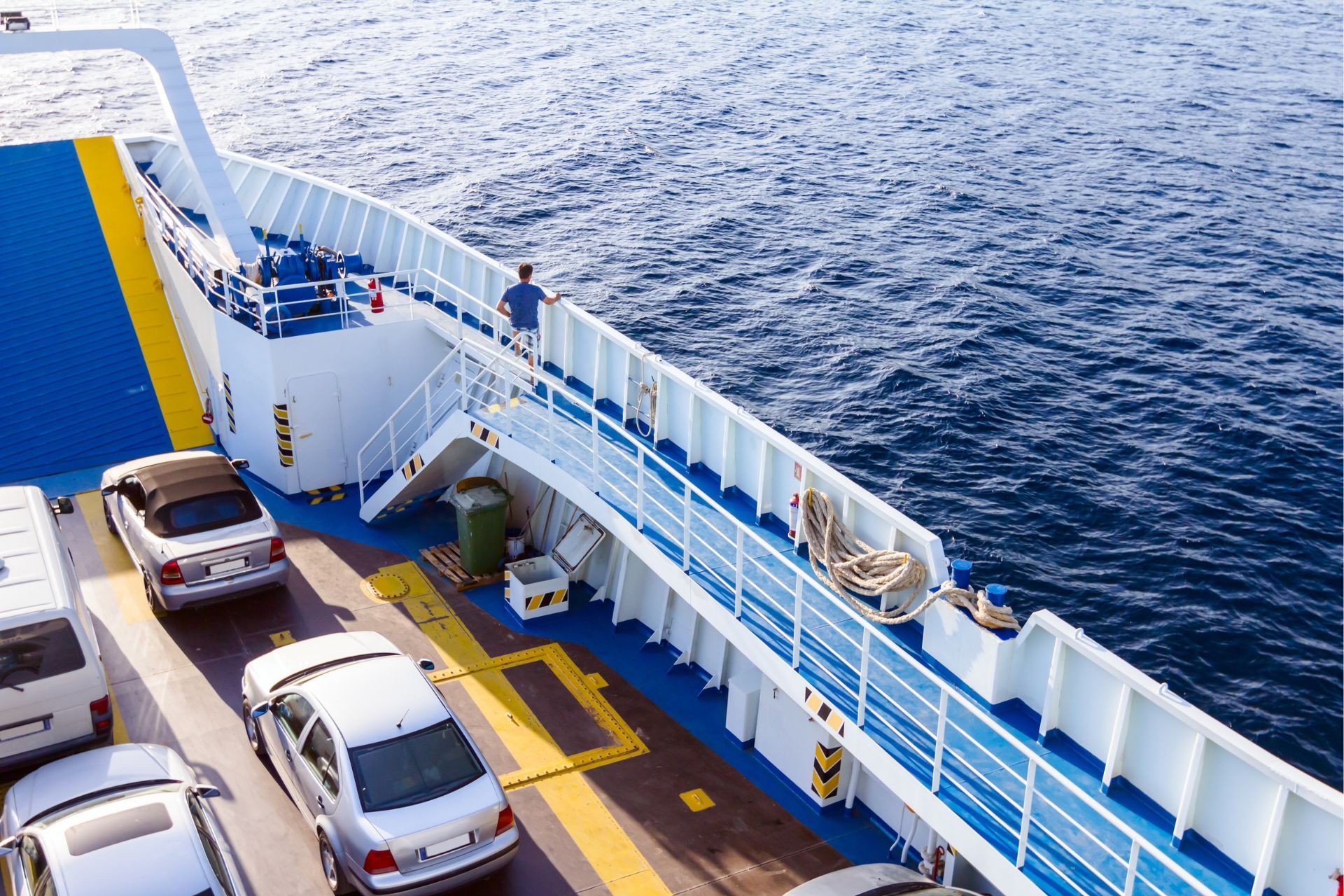
At the port, follow the staff directing vehicles towards the correct ferry and loading lane. The driver boards the vehicle onto the car deck following crew instructions, while passengers may be asked to leave the vehicle before loading.
If you are using the rent-per-island strategy, the process is much easier. Return the rental car, board as a foot passenger, collect your luggage on arrival and pick up your next vehicle at the new destination.

When flying + renting beats the ferry
Greek ferries are part of the experience, but they are not automatically the best option for every itinerary.
For longer routes, flying and renting locally can save a significant amount of holiday time. This is particularly true if you are travelling from Athens to an island with frequent flights and only have a few days available.
A ferry makes more sense when islands are close together. Paros and Naxos are a perfect example because the crossing can take around half an hour. Flying between them would make little sense.
From Athens to Crete, however, the calculation is different. A ferry can take eight hours or more, while a flight takes around an hour.
The best Greek island hopping itinerary is therefore a combination. Fly the long distances, ferry between neighboring islands and rent locally wherever having a car gives you more freedom.
Read: Driving in Greece: 12 rules tourists learn the hard way.
With convenient Abbycar locations across popular Greek islands, you can step off the ferry, collect your next car and keep exploring Greece at your own pace.
Sometimes, but you need to check your rental agreement first. Many rental companies restrict ferry transportation or require prior permission, additional insurance or an extra fee.
It depends heavily on the route, ferry company, vehicle and season. As an indication, transporting a car between Paros and Naxos can start at around €35, while Piraeus to Heraklion can start at around €80. Passenger tickets are charged separately.
Yes, especially in July and August. Vehicle decks have limited capacity, and car spaces can sell out even when passenger tickets remain available.
Crete and Naxos are among the strongest choices because of their size and the number of beaches, villages and attractions spread around the island. A car is also useful on islands such as Paros and Skiathos when you want to explore several beaches or quieter areas in the same day.
For most island-hopping itineraries, separate rentals are the simpler option. You avoid ferry vehicle charges and possible rental restrictions, while paying for a car only where you really need one.

AbbyCar Car Rental Experts
Car Rental & Travel Mobility Experts
Abbycar’s articles are created by experienced car rental professionals specializing in international travel. With deep knowledge of rental processes, insurance, and local regulations, our goal is to provide accurate, transparent, and reliable guidance to travelers worldwide.
For more travel advice and car-rental insights, visit AbbyCar Blog